Brisbane City Council's planning scheme is comprehensive, but when evaluating residential...
Agents often get asked: "Why can't they just pay top price now?" This particularly applies to larger and more complex development sites (the dynamics on smaller, simpler sites can be quite different). Here's my view on what's happening when we structure offers - and why those structures often protect the vendor's interests rather than working against them.
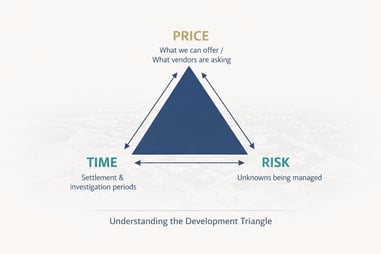
The Development Triangle
In property development, price is primarily a reflection of risk. Time is one of the most powerful tools we have for managing that risk.
The three factors at play:
- Price (what we can offer / what the vendor is asking)
- Time (settlement period and investigation period for due diligence)
- Risk (what unknowns we're managing, and how we account for them)
What "Risk" Actually Means
A few of the unknowns that need to be accounted for include:
Site constraints: Flooding, environmental protections, infrastructure access, heritage, and bushfire considerations. Depending on their extent, it takes time to fully understand the implications and impact of these constraints.
Likelihood of approval: Councils have a good grounding in their planning codes. The challenge comes with more complex sites - what's on the map doesn't always match the reality on the ground. Also, community sentiment and attitudes towards density and amenity can shift over a project's life, creating moving targets. Navigating these is part of what needs to be accounted for in risk assessments.
Government body delays: State departments and environmental authorities operate on completely different timelines than local councils. Depending on what overlays apply - bushfire, heritage, environmental, flooding - this can dramatically impact investigation timelines and approvals pathways. A colleague recently waited 6 months just to get a meeting about an outdated environmental overlay, then another 3 months for any clear direction. Fortunately, the vendor was able to work with them on timelines, so they were able to secure the outcome and pay the higher asking price.
The Three Pathways I See
Pathway 1: De-risked Price
When vendors have time flexibility, developers can often commit to a higher price upfront on the assumption key risks can be resolved during due diligence. The investigation period protects the vendor by ensuring the developer has done the work to confidently pay that higher price when it comes time to settle.
More time for investigation = higher confidence = higher price we can offer.
Pathway 2: Speed-Driven
Sometimes vendors need to move quickly - they've purchased their next home, family circumstances are changing, or they don't want the holding costs and stress of a lengthy process. It is worth understanding: is a short settlement just a 'nice to have' or is it a genuine need? We can accommodate shorter timelines, but the price often reflects this with limited investigation time.
This is where understanding what's driving the vendor's timing matters - it changes the equation.
Less investigation time = higher risk = less ability to justify higher prices
Pathway 3: Balanced Approach
This is the most common scenario and balances the needs of both buyer and seller. A middle path where the focus is on investigating the biggest risk items first while maintaining momentum. The investigation effort gets focused strategically to keep things moving, in line with what the vendor needs.
Strategic investigation focus = balanced timeline and price.
Why This Actually Protects Vendors
Here's why matching the structure to the situation actually matters: when the contract terms align with both the vendor's priorities and our investigation requirements, there's a much higher chance the deal proceeds smoothly. The vendor gets terms they can plan around - clear timelines and conditions that match their actual priorities, not just numbers on paper. A deal that settles cleanly serves everyone better than one that looked good on paper but couldn't get across the line.
About Certainty
What a good offer "offers":
- Process certainty: a clear pathway and timeline for engagement
- Price certainty: the agreed price holds when we meet the agreed conditions or outcomes.
How These Trade-Offs Play Out
The reality is that achieving high prices on development sites is all about managing risk, and time is usually the required resource to make that happen. We all know this isn't always possible. Life events or personal circumstances may require faster resolution. That's where understanding the trade-offs becomes valuable.
What I look at first is always: can we investigate the big risks properly? That drives everything else. The best outcomes I've seen happen when there's clarity on the vendor's priorities - timing (for whatever reason), price maximization, or certainty - then matching that with the right contract terms. Understanding what's really driving their decision helps match them with the pathway that actually works.
We're all striving for the same result: a deal that settles!